
Cornhole Board Size
A regulation cornhole board is 2 feet wide and 4 feet long with a 6-inch hole, a front edge 2.5 to 4 inches off the ground and a back edge 12 inches high, and the boards sit 27 feet apart. This page lays out all the official dimensions and court distances, and the calculator works out the board angle, leg length and cut list for building your own.
- Free to use
- No sign-up
- Runs in your browser
Cornhole board build calculator
Cornhole Board Plans Pack
Printable cornhole plans: dimensioned regulation board plan, leg and pivot drilling template, court layout, scoresheets and a tournament bracket, plus an Excel cut list and materials cost sheet.
- Board plan (PDF/DOCX)
- Court layout (PDF)
- Cut list and cost (XLSX)
- Scoresheet (PDF, XLSX)
- Bracket (PDF)
Formats: PDF, DOCX, XLSX. Instant download after payment (link valid 72 hours, up to 5 downloads). AI-assisted: the templates were drafted with AI help and reviewed and laid out before publishing.
$5.00 USD, one-time 5 files · about $1.00 each
- Instant download
- 7-day refund
- Secure checkout by Stripe
7-day money-back guarantee. Full refund within 7 days of purchase, even after you download.
Free sample: Regulation Board Plan (PDF, 62 KB)
Full refund within 7 days — see the refund policy and license.
Free printables
Single sheets you can print right now, no sign-up. The full pack adds every sheet in one download plus the editable files.
 Printable Cornhole Board Plan
 Printable Cornhole Court Layout
 Printable Cornhole Cut List and Cost
 Printable Cornhole Scoresheet
 Printable 8-Team Cornhole Bracket
Regulation cornhole board dimensions
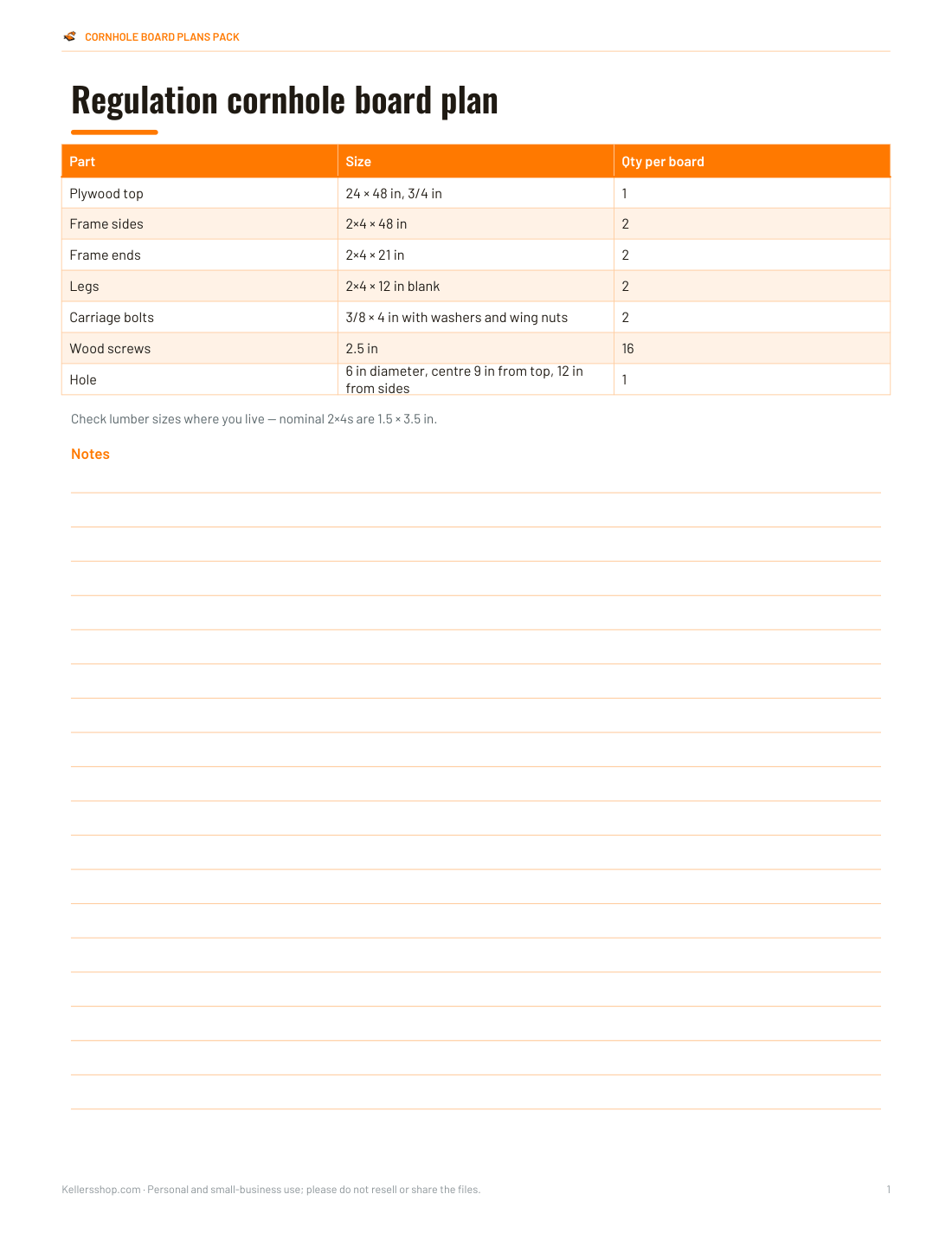
| Part | Regulation size |
|---|---|
| Board surface | 24 × 48 in (2 × 4 ft) |
| Top thickness | At least 1/2 in plywood (3/4 in is common) |
| Hole | 6 in diameter |
| Hole position | Centre 9 in from the top edge, 12 in from each side |
| Front edge height | 2.5–4 in from the ground |
| Back edge height | 12 in from the ground |
| Bags | 6 × 6 in, about 15–16 oz, filled with resin or corn |
These dimensions follow the rules published by the American Cornhole League (ACL) and the American Cornhole Organization (ACO), which are used for most organised play. Casual backyard boards often vary, but building to regulation size means you can practise for leagues and tournaments.
Court layout and distances
| Measurement | Regulation |
|---|---|
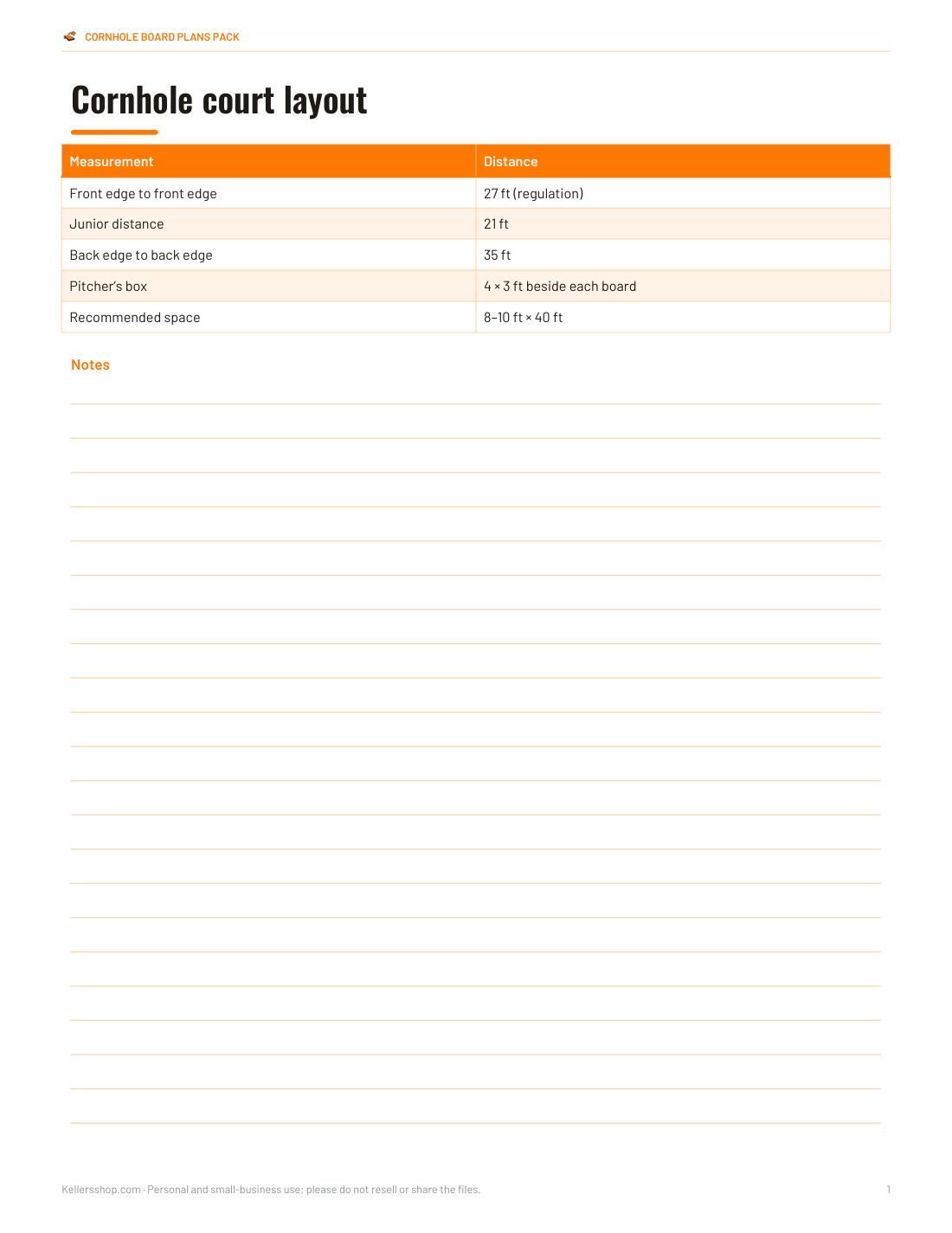
| Distance between boards | 27 ft from front edge to front edge |
| Junior or casual distance | 21 ft is common for children and beginners |
| Pitcher’s box | The 4 × 3 ft area beside each board where players stand |
| Foul line | Level with the front edge of the board |
| Space needed | About 8–10 ft wide and at least 40 ft long, allowing room behind the boards |
Measure from the front edges of the boards, not the backs. With 4-foot boards, the back edges end up 35 feet apart.
How the build calculator works
- Choose the board size and enter the front and back heights you want.
- The board angle comes from the height difference over the board length: sin(angle) = (back − front) ÷ length.
- It locates the leg pivot bolt — by default 3.5 in from the back end, at the middle of the frame depth — and works out its height above the ground.
- Leg length is the pivot height plus half the frame depth for the rounded top.
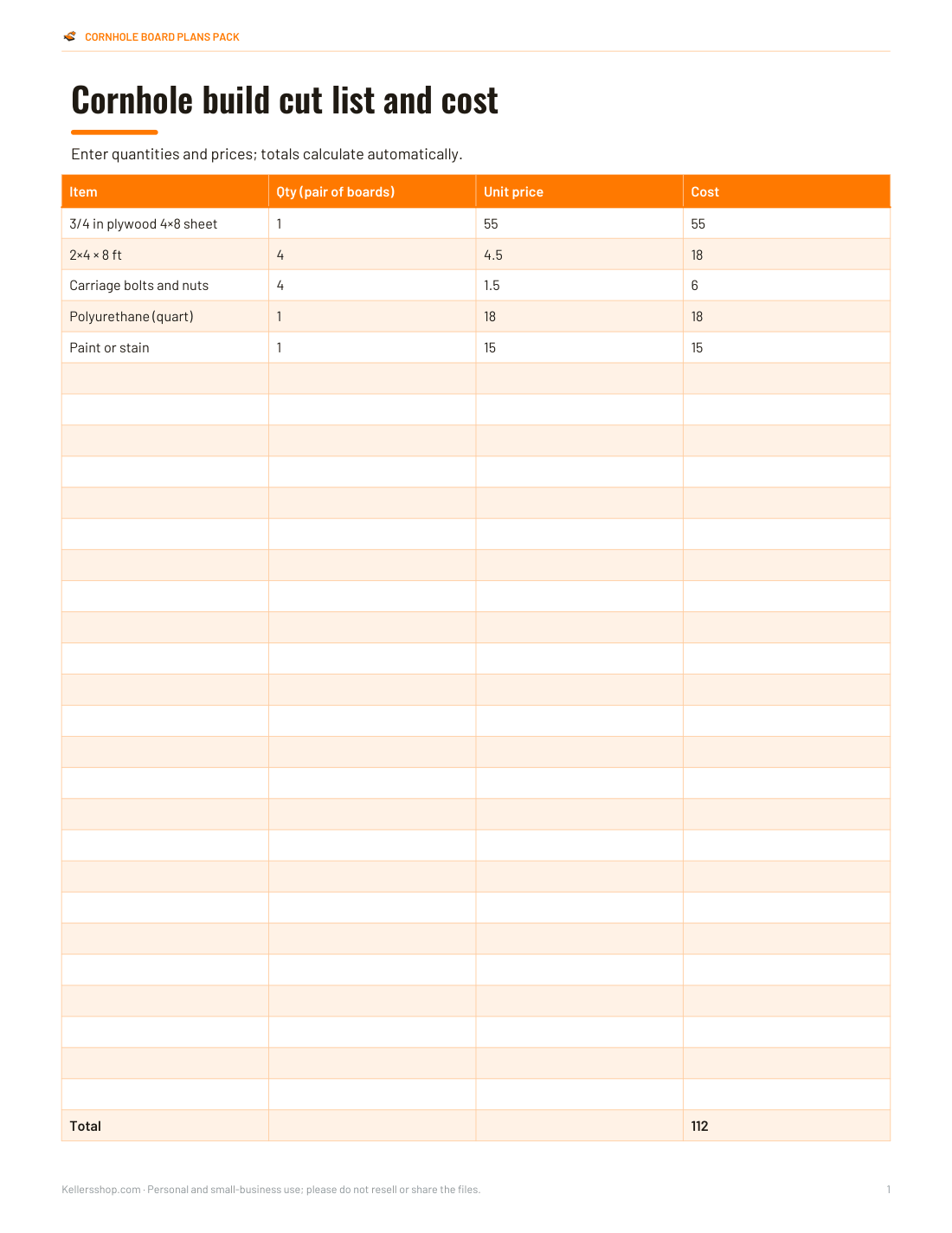
- It lists the parts to cut for one board.
Always dry-fit the legs before the final cut: clamp the board at the target height, fold a leg down and mark where it meets the floor.
Worked example
For a regulation 48 × 24 in board with a 3-inch front, a 12-inch back, a 3/4-inch plywood top and a 2×4 frame on edge, the board angle is about 10.8°. With the pivot bolt 3.5 inches from the back end, the pivot sits about 8.9 inches above the ground and each leg needs to be about 10.6 inches from floor to the top of its rounded end. Cut the legs from 12-inch blanks, drill the pivot hole 1.75 inches from the top, round the top with a jigsaw and trim the foot after a test fit.
Choosing materials
- Top: 3/4 in cabinet-grade plywood (birch or sanded pine) gives a smooth, bounce-free surface.
- Frame: straight 2×4s on edge are sturdy; 1×4s make lighter boards.
- Finish: several coats of water-based polyurethane; sand lightly between coats so bags slide consistently.
- Hole: mark with a 6 in circle template and cut with a jigsaw, then sand the edge smooth.
- Hardware: 3/8 in carriage bolts with washers and wing nuts let the legs fold for storage.
Scoring basics
A bag in the hole scores 3 points; a bag resting on the board scores 1. In cancellation scoring, the points of the two players or teams in a round cancel each other out, and only the difference is added. Games are usually played to 21 points. The printable pack includes scoresheets and a bracket for small tournaments.
Painting and decorating boards
Prime the plywood first, paint the design with exterior-grade paint, then seal with clear polyurethane. Vinyl decals are a quick way to add logos. Test the slide with a bag once the finish has cured; if bags stick, sand lightly and add another thin coat.
Rules of play in brief
- Each player has four bags per round and throws from the pitcher’s box beside the board.
- Players alternate throws until all eight bags have been thrown.
- A bag must be delivered underhand and land without touching the ground first to count.
- Your foot must not pass the front edge of the board (the foul line) when you release.
- The team that scored in the previous round throws first in the next.
Tailgate and mini boards
Smaller boards are popular for tailgating, travel and children. There is no single standard for them; 36 × 18 in and 24 × 12 in are common, usually with a proportionally smaller hole and shorter throwing distance. The calculator scales the hole position for these sizes so the layout looks right.
The printable plans pack
The template pack includes a dimensioned regulation board plan, a leg and pivot drilling template, a court layout diagram, cornhole scoresheets and a tournament bracket — PDF, Word and Excel.
Frequently asked questions
What size is a regulation cornhole board?
24 × 48 in with a 6 in hole.
How far apart are cornhole boards?
27 ft from front edge to front edge in regulation play.
How high is the back of a cornhole board?
12 in from the ground; the front is 2.5–4 in.
Where is the hole on a cornhole board?
Centred 9 in from the top and 12 in from each side.
How long should cornhole legs be?
It depends on the frame; the calculator estimates it — typically about 10–11 in for a 2×4 frame.
How much do cornhole bags weigh?
About 15–16 oz each.
What plywood is best for cornhole boards?
3/4 in cabinet-grade plywood such as birch gives a flat, bounce-free surface.